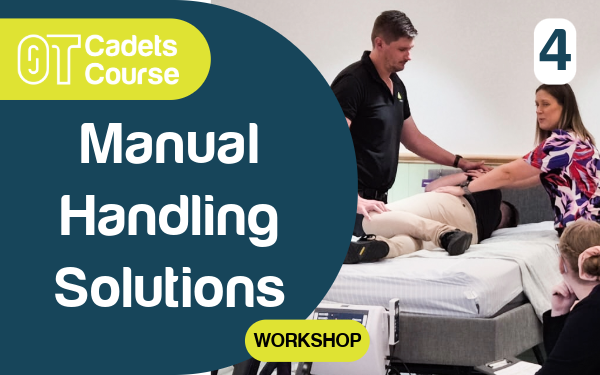
OT Cadets course: manual handling solutions - QLD
Date: Thursday, 19th March 2026
Time: 10:00AM - 12:00PM
Venue: Venue 114, 114 Sportsmans Parade, Bokarina QLD 4575
Presenter: Lucinda Blundell - AMS
CPD Points: 2 CPD Points
Manual handling is often a core component in occupational therapy assessment and treatment, as well as in providing guidance or instruction to caregivers/carers and clients.
Manual handling is any activity in which the body exerts force to lift, lower, push, pull, carry, move, hold, or restrain any object or person. If done incorrectly, manual handling can become hazardous, and if the risks associated with hazardous manual tasks are not eliminated or minimised, they can cause significant and even irreversible injuries or disorders.
We explore the correct procedures for manual handling, the importance of correct manual handling techniques, how to conduct a risk assessment, and how to equip yourself with the skills to identify incorrect techniques.
We also delve into the essentials you need to know to better understand a client’s mobility status and how to use the right assistive equipment to suit the client and their carer’s manual handling needs.
At the end of this workshop, you will be able to:
- Understand the importance of correct manual handling techniques.
- Confidently explain basic manual handling techniques to clients, caregivers/ carers
- Identify possible equipment options from your assessments.
- Obtain a greater ability to Identify, assess and control manual task risks.
All attendees will receive an attendance certificate for their professional development requirements.


Lucinda Blundell is an Occupational Therapist who graduated with First Class Honours from Western Sydney University. She has extensive experience across a wide range of clinical environments, including acute hospital settings, and spent a decade specialising in hand therapy.
Lucinda’s subsequent work has focused on complex wheelchair prescription, seating, and positioning, with particular expertise in custom‑moulded seating, sleep positioning, and pressure mapping. She now contributes to the Active Mobility Clinical Education Team, where she supports clinicians in developing their skills and confidence in prescribing assistive technology.
Lucinda is committed to evidence‑based practice and collaborative clinical education, with a strong interest in empowering therapists to achieve optimal outcomes for their clients.